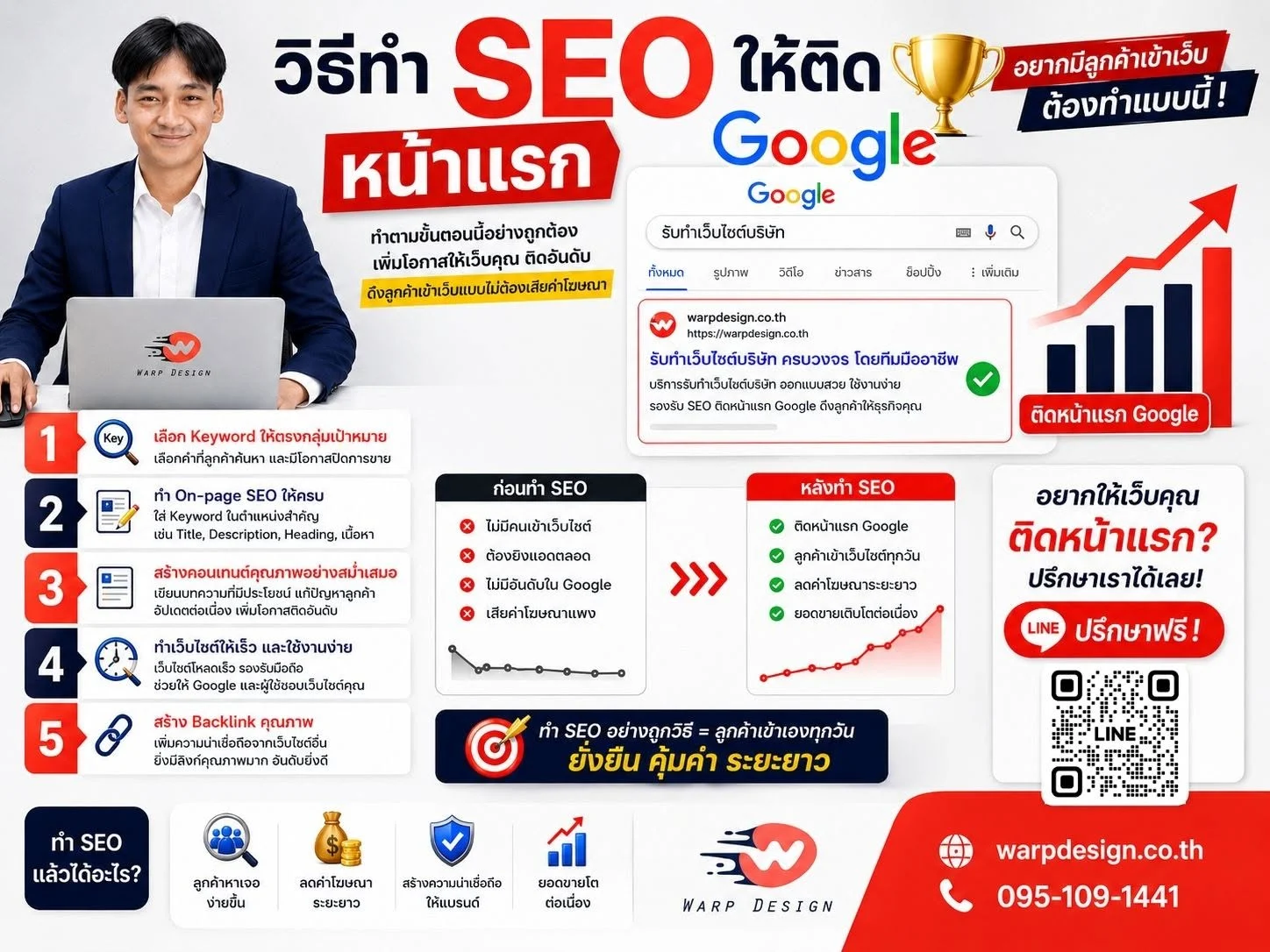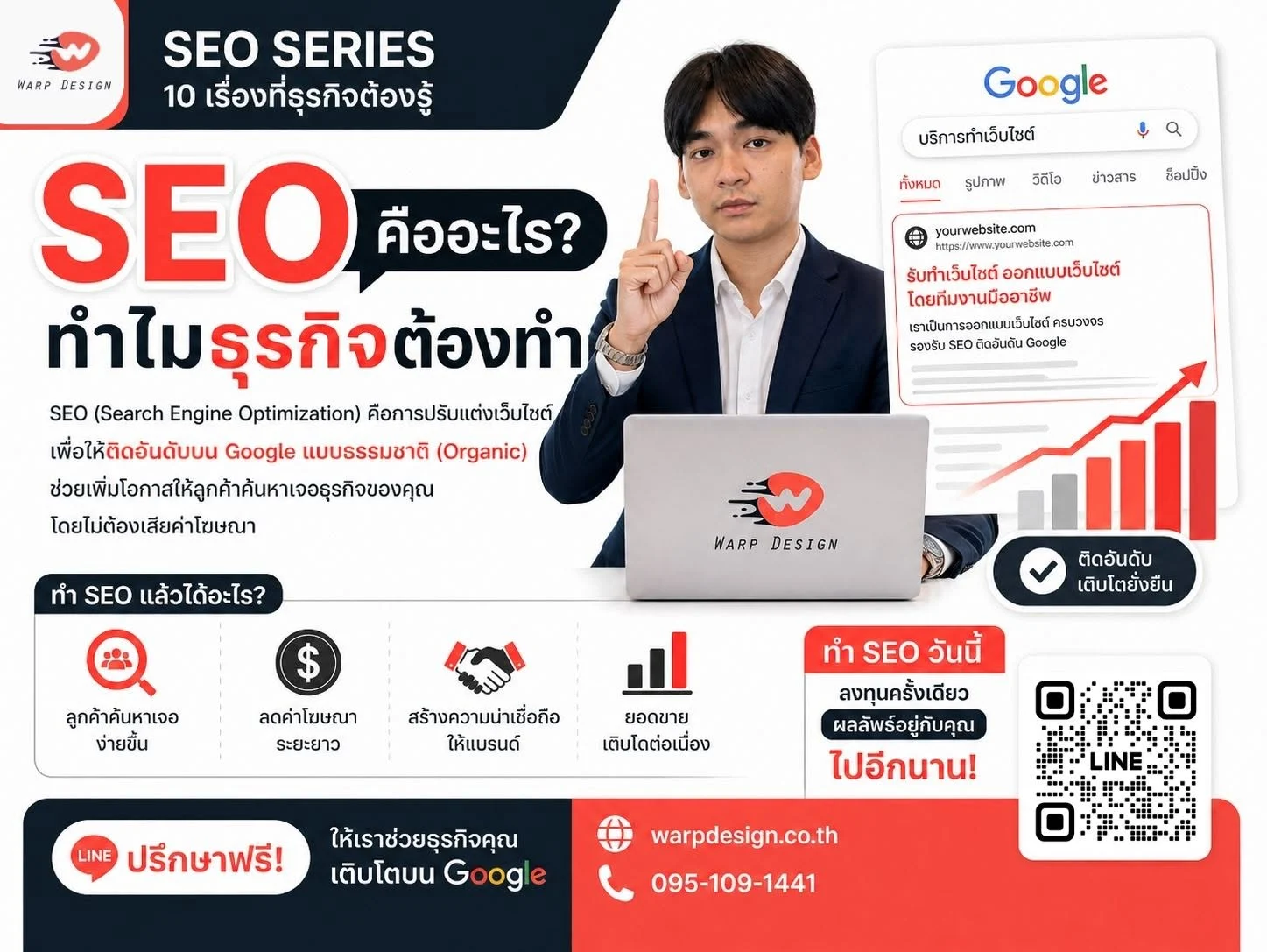
What Is AI SEO? Help Customers Discover Your Business in AI Search
Published · By ทีม WARP DESIGN
AI SEO improves a website and its content to support discovery in AI search experiences. Start with SEO fundamentals, clear service information and verifiable evidence; inclusion and recommendations are never guaranteed.
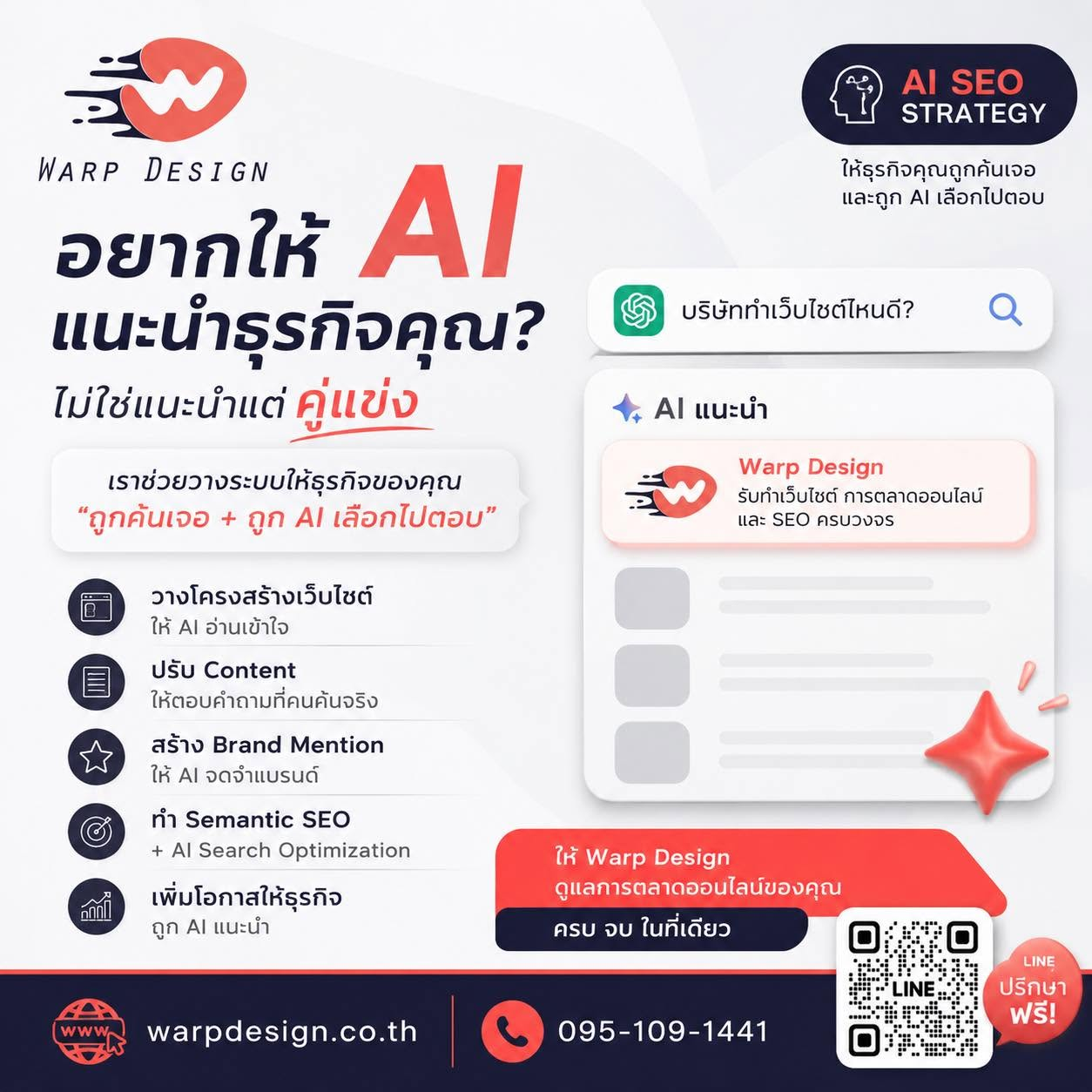
Build an accessible website, useful answers and a consistent business identity to improve discoverability in search and AI experiences, without promises of rankings or recommendations.
When a customer asks “Which website agency should I choose?”, a business wants its information to be useful to that decision. AI SEO starts with a website that explains what the business offers, provides credible information and answers real buying questions.
The cover is a conceptual illustration of AI search and recommendations. It is not an actual recommendation or an endorsement of WARP DESIGN by an AI provider.
What is AI SEO, and how does it relate to SEO?
Here, AI SEO means improving a website and its content to support discovery and citation in AI search experiences. AEO and GEO are other industry labels for related work; they do not replace SEO fundamentals.
Google says established SEO practices remain relevant to AI Overviews and AI Mode, without special AI-only requirements. Meeting those practices does not guarantee indexing or inclusion. Read Google Search Central guidance.
Five areas to review before investing in AI Search
1. Make important public pages accessible
Check your company, service and contact pages. Visitors should be able to open them, follow working links and read essential information as text rather than only inside an image. Ask your web team to review indexing, navigation and settings that may block public pages, while keeping administration and private customer information protected.
For ChatGPT Search, OpenAI distinguishes OAI-SearchBot, used for search, from GPTBot, associated with model training. Their permissions can be managed independently. Allowing search access does not mean allowing every crawler or guaranteeing a place in an answer. See OpenAI crawler documentation.
2. Answer questions that affect a purchase
Collect questions from sales chats and customer conversations: who the service suits, what is included, what the customer must prepare and who handles support after delivery. Use plain language and explain the conditions that matter.
Instead of only saying “full-service website development”, explain whether customers can edit content, whether mobile design is included, how domain and hosting costs are handled, and which revisions are covered by the agreement. Publish only verified details of services actually offered.
3. Connect related topics with semantic SEO
Organize pages around what customers need to understand. A website service page can link to relevant work, an article comparing website types and a page explaining maintenance. Give every page a clear purpose and a useful next step.
This is a practical navigation and content approach, not a reason to create nearly identical pages for every variation of a keyword.
4. Keep business information consistent and verifiable
Use a consistent business name, website, contact details and service description across channels you manage. Publish genuine work and authorized testimonials with enough context to check them. Do not manufacture reviews or third-party mentions to influence search systems.
A brand mention should result from real business activity and useful information, rather than a promise that AI will remember or recommend a company automatically. Google also cautions against seeking inauthentic mentions. Read Google's generative AI search guide.
5. Give readers evidence they can assess
Explain your workflow, show work you are permitted to share, identify the author or reviewer and update information when services change. If you report results, include the measurement period, method and limitations. Avoid unsupported success figures.
If you use structured data, it should match information visible to visitors. Do not add nonexistent prices, reviews or services, and do not present any markup as a guarantee of AI inclusion.
A practical example for a service business
A website agency serving SMEs could organize a service page around the problem it solves, suitable business types, inclusions and exclusions, the working process, related projects, common questions and a way to request an assessment.
This is an editorial example, not a platform requirement. The aim is to help a reader understand the offer, identify important conditions and decide what to ask next.
How should you measure AI SEO?
Record a baseline before making changes. Choose measures your business can reliably track:
- Accessibility and indexing status of important service pages.
- Relevant search queries and clicks.
- Visits from AI referral sources your analytics can identify.
- Phone, LINE and form actions, excluding tests.
- Customer questions and the proportion of enquiries that fit your target audience.
Google includes traffic from its AI features in Search Console's Web reporting, so total search clicks should not be labelled as AI traffic alone. When testing AI answers, record the prompt, date and cited links. Treat a single answer as an observation, not proof of lasting visibility.
Start with work your business can control
- Audit the website: review core service pages, contact details, links and access problems.
- Improve sales information: use real customer questions and confirmed service documentation.
- Connect supporting evidence: link relevant work and helpful content.
- Review the results: compare the baseline with later data and use enquiry quality to guide improvements.
Timing depends on the website, competition and each platform's processing. A fixed deadline for an AI recommendation is not a credible promise.
Discuss your SEO and AI Search plan with WARP DESIGN
WARP DESIGN can discuss website structure, service content and an SEO plan suited to your business. Agree on the scope and measurement approach before work begins. The goal is stronger information and better discoverability, without promising rankings or AI endorsements.
Explore SEO & AI SEO · Website development · Contact WARP DESIGN
Further reading
- Google Search Central: AI features and your website
- Google Search Central: Optimizing for generative AI search
- OpenAI: Overview of OpenAI Crawlers
Reviewed on 13 November 2026. Platform features and guidance may change.